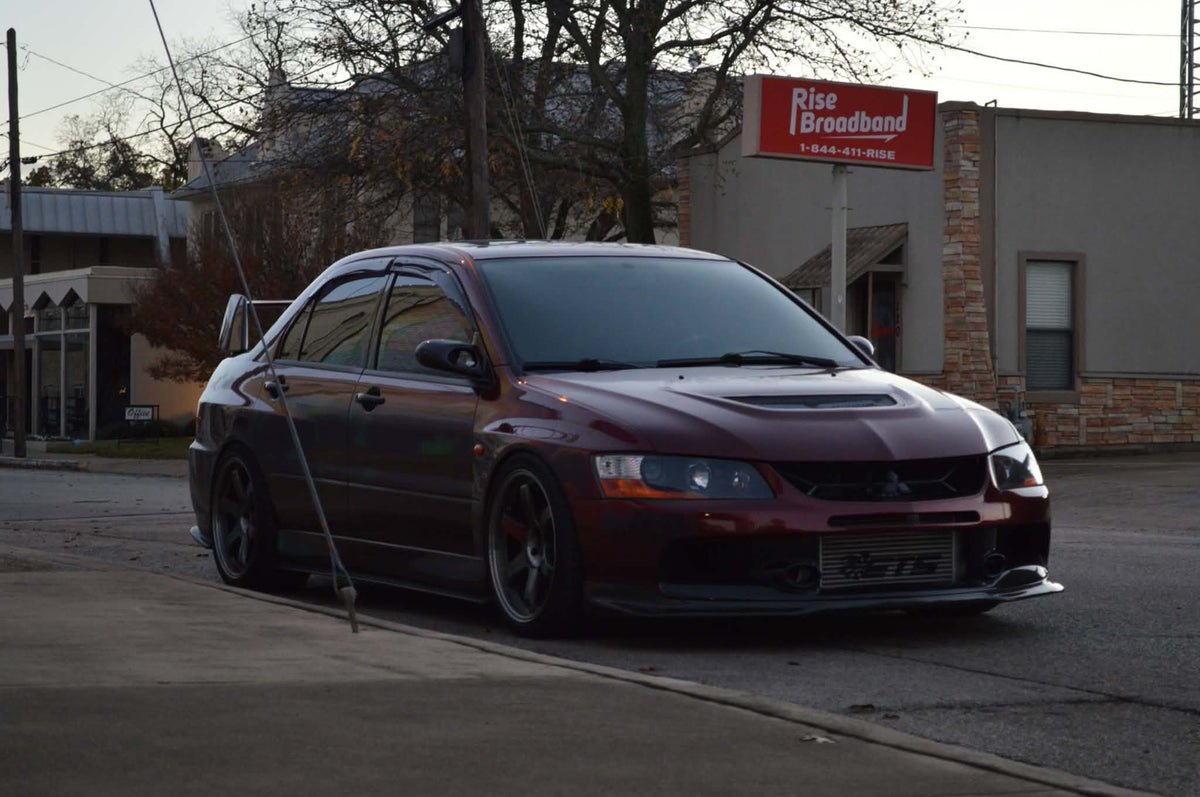
From a bare chassis to a purpose-built drag car, Lance Titus has spent 11 years turning his vision for a 2003 Mitsubishi Lancer Evolution VIII into a one-of-a-kind machine.
For some people, cars are simply a way to get from point A to point B. For others, they become a lifelong passion, a creative outlet, and a constant opportunity to learn something new. For Lance Titus of Rowlett, Texas, that passion started the moment he began driving, fueled in part by the impact of The Fast and the Furious and the automotive culture it helped bring into the spotlight.
Today, Lance works as a technician at Evolution Dynamics, where his experience and enthusiasm for performance vehicles continue to grow. His personal project, a heavily modified 2003 Mitsubishi Lancer Evolution VIII, represents years of hard work, hands-on fabrication, and a clear vision of what he wanted the car to become.
With a built 2.2-liter engine, a forward-facing 6466 turbocharger, a Liberty dogbox transmission, extensive custom fabrication, and a distinctive Stryker Green finish inspired by the Dodge Viper, this Evo is far more than a collection of performance parts. It is a reflection of the builder behind it.
A Love for the Evo Platform
Lance's interest in the Mitsubishi Evolution began when the platform first appeared. After purchasing his first Evo, he quickly developed a deeper appreciation for what the platform could do and the possibilities it offered for performance modifications.
His current Evo VIII is his second Evolution, and he has now spent 17 years in total owning and working with Evos. He purchased the car from Todd, who had previously acquired it from Terence at T1 Race. When Lance took ownership, the project began as a chassis, leaving him with the opportunity to build the car around his own ideas. He has owned this particular Evo for 11 years, steadily transforming it into the machine it is today.
Starting with a bare shell gave Lance the freedom to create something personal, but it also introduced one of the biggest challenges of the entire project. Building a car from the ground up means that every detail matters. Every bracket, line, connection, and component requires time and attention before the bigger picture can come together.
For Lance, that process has been a major part of the experience.
Building the Foundation: A Purpose-Built 2.2L Engine
At the heart of the Evo is a built 2.2-liter engine designed around a serious performance goal.

The combination includes a Kia cylinder head, custom pistons, and 162 mm connecting rods. Airflow comes from a forward-facing 6466 turbocharger, with all the hot-side components ceramic coated as part of the setup.
The drivetrain features a Liberty dogbox transmission, giving the build a transmission package suited to its drag-racing ambitions. An M&W CDI ignition system supports the engine setup, while custom chassis and engine harnesses help integrate the vehicle's extensive mechanical and electronic systems. The target for the next tune is approximately 1,000 horsepower, putting the Evo firmly in high-powered drag-car territory.
Rather than relying on a simple collection of bolt-on upgrades, Lance has approached the car as a complete system. The engine, transmission, chassis, fuel delivery, electronics, and supporting hardware have all been considered as parts of a larger performance package.
Chassis, Suspension, and Drag-Racing Hardware
Producing serious power is only part of the equation. Putting that power to the ground requires a chassis and suspension setup capable of supporting the car's intended use. Lance's Evo features Megan Track Series coilovers, billet rear toe arms, billet control arms, and a tubular front crossmember. These components contribute to the car's custom chassis configuration and support its focus on drag-strip performance. Braking hardware includes STM drag brakes at both the front and rear, while an STM parachute kit adds another important component to the car's high-speed drag-racing configuration. The wheel and tire combination stays true to the car's purpose: 15-inch JEGS racing wheels paired with Hoosier Quick Time Pro tires. Lance also incorporated numerous EvoSpec titanium bolts and billet components, adding specialized hardware throughout the build.

The supporting hardware may not always receive as much attention as a large turbocharger or a horsepower figure, but it plays an important role in creating a cohesive performance build. Every component needs to work with the car's goals rather than against them.
Electronics: The Brains Behind the Build
One of the standout aspects of this Evo is its extensive electronics package.

The car uses an Ecumaster EMU Black engine management system, paired with an Ecumaster dash, a 12-button CAN keypad, and a power distribution module (PDM). Custom engine and chassis wiring harnesses help bring the systems together, creating a setup designed around the needs of the vehicle rather than a generic off-the-shelf arrangement.
Modern performance builds rely on much more than mechanical upgrades alone. Engine management, electrical distribution, driver information, and system integration all contribute to the overall package. With so many systems incorporated into this Evo, the electronics are one of the most distinctive elements of the project.
Custom Fabrication Throughout
Ask Lance about the most unique parts of his Evo, and the answer goes beyond the engine or turbocharger.
Several components have been custom-made for the car, including the catch can, radiator overflow tank, and intercooler. These pieces are among the more noticeable examples of the fabrication work incorporated throughout the project. The car also features Evolution Dynamics fuel lines, catch can lines, boost lines, and a power steering kit, along with an Evolution Dynamics billet oil filter housing.
These details demonstrate how a build can evolve beyond selecting parts from a catalog. Sometimes, the right solution requires designing or fabricating a component specifically for the vehicle. That process takes time, particularly when the starting point is a bare chassis. But it also creates opportunities to develop parts, refine designs, and learn more about how the vehicle works as a complete system. Lance has built the car himself with help from Powerhouse Racing and Evolution Dynamics, combining personal hands-on work with the knowledge and experience of others in the performance industry.
Stryker Green: A Color With Personality
Performance numbers tell one part of the story, but the Evo's appearance makes an immediate impression of its own.
Finished in Stryker Green, a color associated with the Dodge Viper, the car stands out from the more familiar colors often seen on Mitsubishi Evolutions. For him, the paint is more than an aesthetic decision. It is part of the original vision he had for the car, and seeing that vision come together is one of the things he appreciates most about the finished build. The color also gives the Evo an identity that extends beyond its mechanical specifications. It is instantly recognizable as a personal project rather than just another high-horsepower Mitsubishi.

More Than a Race Car
Although the technical side of the Evo is extensive, Lance's approach to cars goes beyond performance figures.
Over the years, getting deeper into automotive culture has allowed him to meet a wide range of people, develop friendships, and learn from others who share the same interests. He recognizes that there is always more to learn, regardless of how much experience someone has. His involvement extends beyond his own garage, too. Lance hosts car meets and remains connected to the enthusiast community through his work and relationships at Evolution Dynamics. That is one of the less obvious benefits of a long-term automotive project: the knowledge gained from solving problems can become useful to other enthusiasts and future builds.
The project has also contributed to the development of parts, allowing some of the experience gained from building and refining the car to extend beyond the vehicle itself.
Advice for Anyone Starting a Build
When asked what advice he would give someone beginning their own car project, Lance emphasizes the importance of defining the goal first.
Before buying parts or chasing horsepower, he recommends deciding what you actually want from the vehicle. A car intended for street driving will have different needs from a dedicated drag car, a show build, or a track-focused project. He also points out that certain modifications can push a vehicle into a different category, changing what it takes to maintain, drive, or enjoy it. Understanding those trade-offs early can help prevent a build from drifting away from its original purpose. Most importantly, he encourages people to enjoy the process. It is easy to get caught up comparing horsepower numbers, elapsed times, budgets, and parts lists. But every project is different, and the right build is ultimately the one that delivers the experience its owner wants.
Looking Ahead to TX2K27
Lance hopes to have the Evo ready for TX2K27, giving the project a major milestone to work toward.
Until then, there is still room for further development, refinement, and experimentation. He looks forward to achieving the car's performance goals, continuing to make changes, and working with manufacturers to explore new ideas. The car's future is not necessarily about reaching a final, unchanging configuration. Like many enthusiast builds, it will likely continue to evolve as Lance learns more, discovers new possibilities, and decides what he wants to improve next. That ongoing development is part of what keeps the project exciting.

The Goal: An 8.90-Second Quarter-Mile
With a target of approximately 1,000 horsepower on the next tune, Lance has his sights set on running an 8.90-second quarter-mile. That goal gives the project a clear direction. The build is intended primarily as a fun drag car, although Lance also wants to enjoy some street driving. The next phase will be about bringing all the work together and seeing what the combination can accomplish on the track. For enthusiasts who appreciate the process as much as the outcome, that is often one of the most rewarding parts of a project like this.
Built Around a Simple Philosophy
After 11 years with this Evo and 17 years of Evolution ownership overall, Lance has invested a substantial amount of time and money into a platform he genuinely enjoys.
His 2003 Evo VIII combines a serious engine and drivetrain package with custom fabrication, extensive electronics, drag-racing hardware, and a color scheme that reflects his personality. But the most important part of the car may be the fact that it represents a vision he has spent years bringing to life. For him, the goal is not simply to build the fastest car or create something that looks impressive in photographs. It is to build a car that delivers the experience he wants, continue learning, and enjoy the people and opportunities that come with being part of the automotive community.
His final advice sums up that mindset perfectly:
“Life is short and just enjoy cars for what you want to get out of them.”
It is a fitting philosophy for a project built through years of patience, hard work, and a genuine love for cars.